Wednesday, April 21, 2010

Nation-Branding: Don't Do It

In a recent article for the Economic Times, Simon Anholt critiques what he sees as indiscriminate use of the phrase "nation branding." Stationery logos are all well and good, he says, but you can't win hearts and minds with a swoosh. The key to improving a national reputation is to be reputable:
The message is clear: if a country is serious about enhancing its international image, it should concentrate on what it does and what it makes, rather than obsess about what it says or how it looks. There are no short cuts. Only a consistent, coordinated and unbroken stream of useful, noticeable , world-class and above all relevant ideas, products and policies can, gradually, enhance the reputation of the country that produces them.

In short, a nation's actions and exports should promote the reputation it wants to have. The rest is just window dressing.

Monday, April 19, 2010

On Russia, With Love

In the home stretch of a semester, many graduate students find they become strangers to their friends, their beds, the finer points of hygiene, etc. Among the many end-of-term projects isolating me from high society over the past few weeks has been a collaborative examination of Russia's public diplomacy with my friend and colleague Lena, which culminated in a presentation and paper, both completed this past week. Huzzah!

Among the many discoveries this project has yielded is this: I am ridiculously enthusiastic about public diplomacy and international communication. I get embarrassingly animated when describing my research, which I do with the sort of fervor people normally reserve for extolling the merits of their grandchildren or fail-proof pyramid schemes. So I'll try to restrain myself here in sharing some of the highlights of my paper:

In 2005, shortly after a Kremlin-commissioned survey showed that the items Americans most associated with Russia included communism, the KGB, snow and the mafia, the Russian government started pumping money into a PD revitalization effort.* One aspect of this effort has been an attempt to re-brand Russia as an innovative, democratic nation with a strong economy and rich cultural history. But despite a massive information machine, cultural exports, language and education programs, exchanges, consulates, cultural centers and impenetrable fortress embassies, Russia's global reputation remains fairly negative.

Attempts to establish a new national identity have been undermined by competing interests that pull Russia toward both the past and the future. More than anything, Russia struggles to shake off its Cold War image--partly because Cold War imagery still colors much media coverage of the country, but also because Cold War attitudes still shape its interactions with the West and its neighbors.

With all the wisdom and confidence of a graduate student who's never set foot in Russia, I offer three suggestions for improving Russia's global brand:
  1. Increase free information flows within the country, and offer more support to critical media and NGO groups.
  2. Increase transparency and stamp out corruption.
  3. Encourage public diplomats to promote stories and events that fly in the face of traditional Cold War narratives and confirm the "new Russia" identity.
For what it's worth, it couldn't hurt to dust off the welcome mat at the embassy either...

Afghanistan's Empty Playgrounds

U.S. public diplomacy acknowledges the importance of engaging foreign youths--but often that term seems to apply to adolescents and young adults, and not the very young.

For a recent NPR piece, Foreign Policy's Anna Badken visited a rural village in Afghanistan, where the child mortality rate is second only to that of Sierra Leone. At a playground near a refugee settlement stands a large billboard, erected by government contractors reading: "Title of Project: Creating Livelihood Opportunities for Refugees in North Afghanistan. Project Code: 02 AFR. Component: Play Ground and safe Play area ... Donor: Bureau of Population, Refugees and Migration (United States of America)."

The playground is underutilized in this part of the country, where potable water is in short supply and jobs are scarce. Many children in the camp have died before they were old enough to appreciate it--not exactly an anomaly in Afghanistan, where 28 children die every hour.

"What the billboard really says," Badken argues, "is that the international aid that is supposed to help rebuild Afghanistan is tragically failing."

From a strategic standpoint, Afghanistan's weak infrastructure is troubling, as poverty and desperation could easily drive youths to join the Taliban. From a humanitarian standpoint, the problem is even more disturbing.

Foreign aid can be a public diplomacy tool, if it represents an understanding of a population's desires. But programs that confirm the donor's ignorance of the recipients needs are unlikely to generate a flood of goodwill. Resources for aid and public diplomacy are limited, of course, and playing is an essential part of development. But you'd be hard-pressed to find a parent who'd rather give his hungry child a see-saw than a loaf of bread.

It's easy to judge the effects of foreign policy from a desk in D.C., and it's hardly fair to chastise an aid project with such good intentions. Ultimately what's underlying this problem--like the foundation of so many public diplomacy issues--is the need for coordination to make sure that intentions, actions and receptions align.

Friday, April 16, 2010

Slipping through the Net

We've all heard the claim that public diplomacy benefits from modern ICTs that facilitate rapid mass communication. But such praise is almost always accompanied by caveats, from Hillary Clinton's January address at the Newseum to James Glassman's speech at the New America Foundation.

Laying aside the inherent value of Internet freedom unto itself, let's ask the PD question: How accurate is the assumption that increased Internet freedom will lead to greater support for U.S. diplomatic goals like support for U.S. governance?

I set out to test this theory, assuming that if Internet usage does, in fact, support PD, nations with higher Internet use rates would be more likely to approve of U.S. governance. I used Gallup-Meridian data to measure the percentage of a country's population that approves of U.S. leadership. To measure Internet access, I turned to the International Telecommunication Union. I'll spare you the statistical jargon, but the countries with a higher percentage of Internet users were actually less likely to approve of U.S. governance--at least in 2008, which is the year I tested.

This could be because increased connectivity provides more opportunities for people to engage online with America's detractors. Or it could be entirely irrelevant--because soft power is so hard to measure, because approval of U.S. governance isn't static across time (or administrations), because public diplomacy takes so long to make its effects known, because so many other factors are at play...

If there truly is a negative correlation between Internet access and approval of U.S. governance, it would behoove the United States to figure out why and how to avoid it. If nothing else, my numbers add a few more caveats on the PD 2.0 fire--one more reminder to be skeptical of unbridled optimism for new technology.


Wednesday, April 14, 2010

Let It Be

On Monday night I attended a presentation on the Vatican's public diplomacy. The takeaway was that the Church largely relies on information distribution, via resources like L'Osservatore Romano, Vatican Radio, Vatican Central Television and the Church website, but that an institutional bias towards secrecy and glacial responses to scandals were major problems.

So it was a surprise to me to learn that the Vatican has issued a rapid response to an issue of grave importance that extends well beyond the Catholic community. I'm talking, as you've probably guessed, about the Beatles, who were praised in L'Osservatore Romano this weekend for their grand contributions to pop music. Benedict, if I may presume to whisper some words of wisdom, I think the church's information and communication specialists may have missed the mark on this one.

I'm hardly the first blogger to suggest the Catholic church is blowing on twigs while the forest burns, but I am sympathetic to its position. For centuries, the Church had a near monopoly on the means of mass communication, and questioning any of its pronouncements was unthinkable. Still, it has had many, many years to adjust to the idea of non-papal broadcasters. If the Holy See wants to succeed in its goal of spreading the gospel and fostering peace and justice for all, it needs to raise its game and its pace in the global public sphere. And it needs to quickly condemn and resolve crises within its own flock--and I don't mean pop tunes.

The Church needs decisive action and rapid responses. Otherwise its message will be shaped, distorted and dispersed by a sea of snarky bloggers before it can even begin, and the Vatican will find itself writing the words to a sermon that no one will hear.

Monday, April 12, 2010

Look On My Abs, Ye Mighty, And Despair!

For many a world leader longing to make a lasting political statement, statuary has proven an irresistible medium. What better way to make your values clear and permanent than to commemorate them in marble? It's like the old saying, "If you love something, carve its head into a mountain."

In that spirit, FP offers a photo essay on some of the world's most misguided political statues, starting with Senegal's controversial tribute to independence/President Abdoulaye Wade's virility. It's what Independence would look like if Independence were a Marky Mark tribute to Soviet stonework. Check out the monstrosities here.

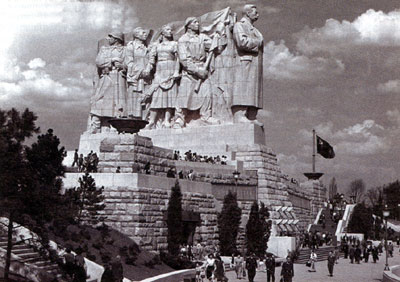
Not included was the world's largest monument to Josef Stalin, a 17,000-tonne marble memorial to the leader standing at the front of what appears to be a bread line. The visionary behind the eyesore committed suicide shortly before it was unveiled and reportedly made out his will to a school for the blind, the only blessed souls who would never have to gaze upon his hideous creation, although I've never been able to determine how accurate/apocryphal that story is.

World leaders, take note: If you want the mighty to look on your works and despair, please make sure your politics and aesthetics are worthy of celebration. The world will thank you for it.