Tuesday, November 2, 2010

Rock the Vote!

I watched the 2004 returns in Prague, at a restaurant so packed with expatriates that the servers could hardly squeeze between the tables. The majority of my American friends (fulfilling stereotypes about young Americans who spend a year or two in Prague) had voted for Kerry, but were almost universally confident that Bush would to win. My foreign friends and students had obviously not voted, but were surprised by the results, and I spent a good part of the next week trying to answer the question: How had Bush been re-elected? None of the people who asked were experts on U.S. domestic policy--and neither was I, for that matter. But I did my best to explain. Mostly, I was surprised by their passionate response to the election.

The fact is, the rest of the world pays far more attention to U.S. politics than U.S. citizens pay to politics in any other country. I've been thinking about that today as the U.S. seems poised to elect a body of inward-focusing politicians. Novelty--and its implication of purity--and domestic growth have been major themes in many campaigns, which means that experience in foreign policy isn't exactly at the top of the agenda for many candidates.

The Economist, like many papers and pundits, argues that Americans are voting in anger. U.S. voters are hardly alone in their disappointment with President Obama. The Right thinks he's done too much. The Left thinks he's done too little. And just about everybody has observed his failure to match rhetorical strength with action. Politico claims that U.S. voters are sending a message to the President with their ballots today. But their message will travel beyond the White House and even beyond the U.S. border. But until the ballots are tallied and the new political line-up is revealed, it's unclear what that message will be.

Monday, November 1, 2010

Cultural Diplomacy as a Listening Project

One week left before the cultural diplomacy conference at American University's School of International Service.

The one-day conference, co-sponsored by the Public Diplomacy Council and the MountainRunner Institute, focuses on one of my favorite themes: listening as an act of diplomacy.It will be held on November 8, 2010, 12:00-4:30pm in the SIS Building's Founder's Room on the AU campus. (directions).


The conference will address three major areas within the greater subject of Cultural Diplomacy:
  • New Social Media and Public Diplomacy 2.0
  • Educational, Cultural Exchanges
  • Cultural Intelligence: Does it include listening?
Speakers will include:
  • Nicholas Cull, Professor of Public Diplomacy, USC
  • Rick A. Ruth, Director of the Office of Policy and Evaluation, Bureau of Educational and Cultural Affairs, U.S. Department of State
  • Edward O’Connell, President, Alternative Strategies Institute, Inc.
  • Sherry Mueller, President, National Council for International Visitors
  • Andrew Kneale, Cultural Relations Project Manager, British Council USA
  • Ben Connable, former head, Marine Corps Cultural Intelligence Program
  • J.P. Singh, Associate Professor of Communication, Technology and Culture, Georgetown University
From the event description:
This one-day event will build upon last year’s successful conference, “Culture’s Purpose and the Work of Cultural Diplomacy.” Our previous meeting provided an opportunity for productive exchange among central stakeholders in the future of cultural diplomacy. It encouraged them to address the question of the efficacy of the concept of culture – how culture works – in the context of cultural diplomacy efforts, as at once: an expressive tool, representative of particular “values,” a vehicle of communication, carrying out creatively transformative effects upon international relationships, or a variety of soft power, among others. While representing diverse starting points and conceiving the role of culture in multiple ways, a notable emergent consensus among the participants in last year’s conference was the urgent need to better understand the cultures of the people with whom we are engaged rather than to continue to promote the virtues of our own culture.... We might summarize the diverse concerns expressed during our previous conference as convergent calls for better “listening,” that is, the need to become better participants in a cultural diplomacy more thoroughly conceived as dialogue. Indeed, we might suggest that, regardless of how culture is understood to be relevant for diplomacy – conceived as a constituent element of public diplomacy, strategic communication, cultural exchange, nation branding, or as initiatives in culture and the arts – a persistent failing of cultural diplomacy as a dimension of public diplomacy has been its radically underdeveloped appreciation for the process of communication as a meaningful cultural act. We propose the need for greater attention to the relationship between culture and communication in diplomacy.

If you wish to attend, please contact my fabulous and only mildly chaotic colleague Yelena.
Want to know more? Click here or e-mail one of the conference organizers: Robert Albro, Craig Hayden or Anthony Quainton.

Sunday, October 31, 2010

Sanity and Discourse

I may not agree with everything Jon Stewart said yesterday at the Rally to Restore Sanity and/or Fear, but it was free, it was fun and it was close to my house. And, as regular readers of this blog know, I'm a big fan of civil discourse.

Stewart's closing remarks were addressed to a domestic audience, but I think some of his advice could be applied to international discourse as well--specifically his recognition of the importance of working together, even when our views are different, and his conviction that it can be done: "...we know, instinctively, as a people, that if we are to get through the darkness and back into the light, we have to work together. And the truth is there will always be darkness, and sometimes the light at the end of the tunnel isn't the promised land. Sometimes, it's just New Jersey."

And while Stewart directed most of his ire at the toxic media sources that dish up fear and hyperbole, I think he could have been a little harder on his audience. Because civil discourse isn't quite enough. We need to be able to listen--with discernment and patience and respect--and that's something most people struggle with on a daily basis.

But I don't want to get too deep here. It's a weekend after all, and I've got plenty of thesis left to write. So I'll close here with some of my favorite photos from the rally. Enjoy!


Friday, October 29, 2010

Pambassadors in the Post

Flipping through the Washington Post this morning, I came across this, a news supplement "prepared by China Daily, People's Republic of China," in the style of Russia Today.

The front page of this six-page pull-out had an environmental focus, with an article on bilateral clean energy ties between China and the United States and an op-ed entitled "Spare a thought for efforts in conservation." The inside was economy-focused, with more articles on green energy, job growth, exporter debt, white collar burnout and the plight of the local factory. The back page even included a story on the nation's new pambassadors.

Of particular interest to this blogger was an article entitled "Military coexistence in new era," which argued that "a review of China-U.S. military relations in recent years reveals two basic facts: First, the two countries and their military leaderships have more than once emphasized their desire to develop bilateral military ties and strengthen communication. Second, the two militaries are dedicated to promoting and stabilizing a friendly relationship between the two countries." A little clunky, but the message is fairly clear: Chinese military power is no cause for alarm, folks; think of us as allies, please.

The presence of the supplement was no surprise. This blog has reported on China's expanding PD efforts before. According to the website, China Daily's U.S. edition was launched in 2009 and "its circulation includes the United Nations Headquarters, government agencies of the United States and Canada, universities, think tanks, major financial institutions and many high-tech companies."

But I have to wonder how effective these supplements actually are. The writing is about as subtle as an episode of Jackass, and it's hard to read stories about the stresses of white collar capitalism without the word "propaganda" popping into your head. And who, exactly, are these supplements targeting? As I understand it, the Washington Post's print subscribers essentially consist of me and a few dozen Luddites scattered around the city. I attempted to call the China Daily offices in D.C. and New York for more information, but went to voice mail both times. China is nothing if not consistent.

***

Update! 12:35pm  When I called the Washington Bureau of China Daily using the number listed in the Washington Post supplement, I reached (as mentioned) a generic answering machine, and hung up without leaving a message. Moments ago I received a reply from that number from somebody who saw my number listed as a "missed call." When I asked if I was speaking to the China Daily office, I was informed that I had a wrong number. Surely the China Daily office will want to correct this immediately.

Thursday, October 28, 2010

Listen Up!


Video courtesy of the Washington Post.

File this under Less Than Shocking: Today's Washington Post reports that an Iraqi television show that empowers citizens to share their concerns about life in Baghdad is popular. The program, called Baghdadia and the People, invites Iraqis to contribute to the public discourse.

As Ali Jumaa, an unemployed man, waited his turn to speak, he explained the appeal of Suheil's show. "This is the people's voice to the government," he said. "He goes everywhere and they see the suffering, not like others who try to pretend everything is fine."

The idea that Iraqis -- or anyone, for that matter -- would appreciate having an opportunity to address their leaders and help shape the narrative of their day-to-day lives, is hardly surprising. What is surprising is how little U.S. public diplomacy does to contribute to initiatives like this, particularly in the realm of broadcasting.

I co-wrote a paper last year discussing this lacuna in U.S. public broadcasting efforts in Afghanistan and Iraq. While some aspects of U.S. engagement in Iraq and Afghanistan are collaborative, U.S. radio broadcasts are often not. As the almost exclusive generator of messages in this context, the United States reinforces existing power dynamics, treating radio audiences, for the most part, as passive recipients of information and not co-creators.

Over the past two decades, new Arab media sources have created an environment in which the public has greater agency in framing and interpreting the news. Programs like Baghdadia and the People and the analytical offerings of Al Jazeera and its imitators create a space for people to frame issues in the public sphere. The United States has been trying to navigate this environment in the post-9/11 world with broadcasts that more closely resembled the unreliable state media programs of the mid-twentieth century than their more popular, populist successors.

It's a shame, really, because there is clearly still a need for bottom-up broadcasting in Iraq.

Wednesday, October 27, 2010

$#*! My Prof Says


Here's another one for the cross-cultural collaboration files:

A while back I quoted one of my professors on the evolution of US foreign policy -- essentially saying that Theodore Roosevelt and Woodrow Wilson laid the foundation on which subsequent presidents built. We've covered a lot of ground over the past few weeks, most of which was covered in a harrowing midterm that spanned two centuries of foreign policy from seven different countries, and now we're focusing on major international issues. This week: globalization.

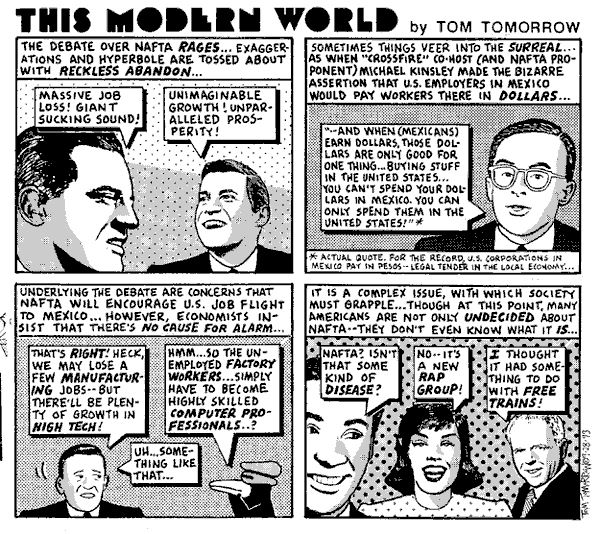
Among our readings, Prof. Pastor has included one of his own pieces, a 2008 article for Foreign Affairs. In it, Pastor addresses a few assumptions about U.S. security and economy and argues that Mexico and Canada have a greater impact on both than any other country. Casting aspersions on NAFTA and immigration (both popular whipping boys during campaign season) does little to improve goodwill in the neighborhood. Pastor advocates for tripartite dialogue, conducted on equal footing (or as equal as possible) between Canada, Mexico and the United States to create "a sense of community and a common approach to continental problems."

Hard power standards like economic collaboration, customs unions, and an investment fund to reduce the income gap between Mexico and its neighbors are part of this strategy. But it also relies on soft power as well, namely in the form of generating goodwill and a Donnesque spirit of common purpose: "A North American approach needs a vision based on the simple premise that each country benefits from its neighbors' success and each is diminished by their problems or setbacks."

It's like that scene in A Beautiful Mind where Russell Crowe deduces that he and his buddies are going to have to collaborate if they want to get lucky, because blind pursuit of personal interests will inevitably lead to going home alone--only slightly less crass and significantly more international. The proposal involves moving away from bureaucratic haggling and towards collaborative solutions. One suggestion involves sponsoring centers for North American studies in each country, to promote regional solidarity. Ultimately, it relies on the assumption that by working together, we stop being part of the problem and start contributing to the solution.